
Fiber Laser Tube Cutter Guide: Selection issues FAQs
When preparing to purchase a laser tube cutting machine, the online promotional materials are overwhelming.As mechanical engineers working on the front lines of the workshop for a long time, we don't pay attention to flashy advertisements, we only focus on solid machining performance and hard-core parameters.
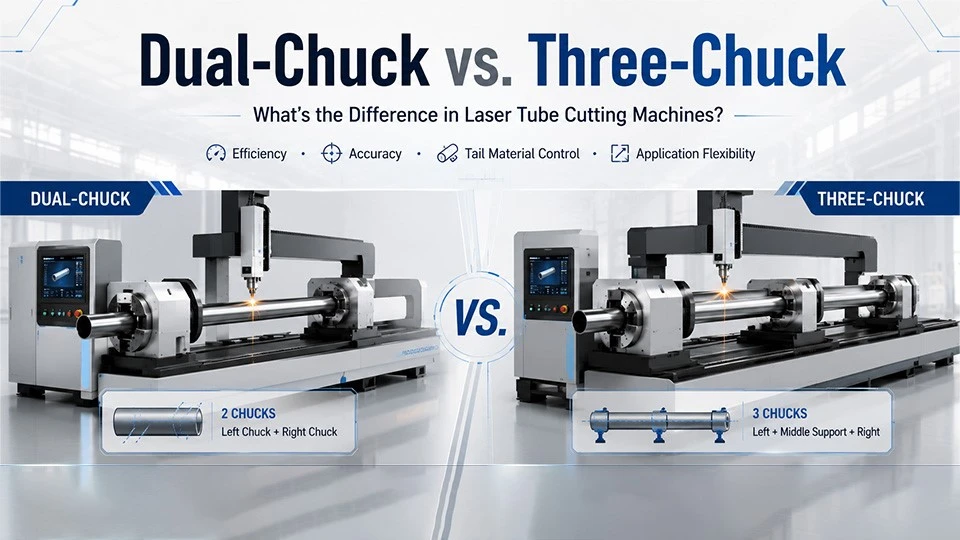
Question 1: Is the "zero tail material" claimed by laser tube cutting machines true? What is the difference between double chuck and triple chuck?
Answer 1: Conventional dual-chuck equipment on the market generally still leaves a section of clamping leftover material, while three-chuck models can barely compress the short material end.This laser tube cutting machine optimizes the dual chuck floating relay clamping and servo feeding program, with dual chucks working collaboratively in an alternating manner to support and feed the material,and the tube end has no mandatory reserved clamping section.At the same time, it can achieve a 6-meter standard full tube is cut completely from end to end, truly achieving no excess waste at the beginning, and ensuring genuinely zero tail-end waste processing.
Selection recommendation: If thousands of tubes are cut every day and the waste cost is very high, the two-chuck solution is the first choice.
Question 2: How thick can a 3000W laser tube cutting machine cut? What are the typical cutting speeds for commonly used materials?
Answer 2: 3000W is the optimal power for processing medium and small tubes, with a significant difference in maximum wall thickness compared to conventional speeds.Based on actual test data from the Qingyun T9-AF6000 solution:
Stainless Steel/Carbon Steel (Nitrogen or Air Assisted):
Standard Machining Wall Thickness: ≤5mm (Extremely high speed, achieving 50-150mm burr-free cut).
Limited Cutting Wall Thickness: 8mm (Slower speed, approximately 16-20mm/s).
Aluminum Alloy (Air or Nitrogen Assisted):
Standard Machining Wall Thickness: ≤4.5mm (Speed 60-150 mm/s).
Limited Cutting Wall Thickness: 6mm.
Carbon Steel (Oxygen Assisted, tube Inner Diameter >50mm):
Standard Machining Wall Thickness: ≤12mm (Speed 25-66 mm/s).
Question 3: Why is it a waste to buy a large chuck when cutting small tubes?
Answer 3: The large chuck has very high rotational inertia and cannot provide the acceleration required for small tube processing. Many bosses are greedy and think, "After buying a large chuck, we can cut large tubes." But if more than 90% of the tubes in your factory are small tubes within 80mm, such as those for bathroom fixtures, hardware, and small furniture,The large chuck will severely drag down efficiency.
The quick cutting of the small tube relies on acceleration: When cutting the corners of short tubes, square tubes, and special-shaped holes, The laser head needs to start and stop frequently and change direction.
Solution for Qingyun T9: specially developed for tube diameters φ13 – φ80mm and square tubes within 60*60mm.Employs a 90 precision lightweight chuck, it features an ultra-high acceleration of 15000mm/s² (1.5G) and a rotational speed of 1280°/s². The machine turns without slowing down, and the small tube cutting is quick and decisive. The overall efficiency is more than 30% higher than that of the bulky large chuck models.
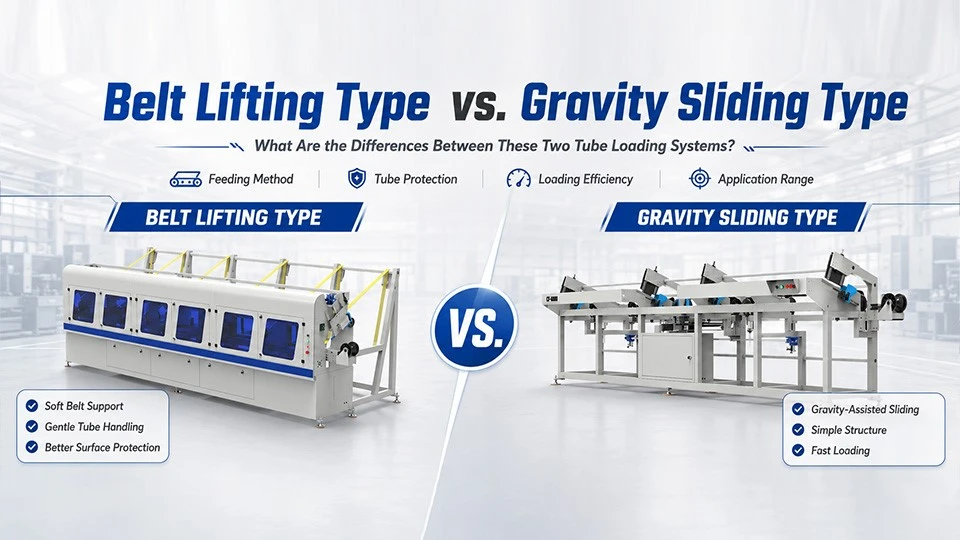
Question 4: How to choose an automatic feeding machine? What are the differences between belt lifting type and gravity sliding type?
Answer 4: The belt lifting type provides excellent surface protection for tubes and is more suitable for thin-walled tubes and fittings with high surface quality requirements.
Gravity/chain slip type (traditional):The tube rolls hard against the steel rail, or falls and hits hard. For thin-walled stainless steel tubes, copper tubes, or aluminum alloy tubes with a thickness of 0.6mm to 1.5mm, deep scratches are very easily caused.Post-polishing and anodizing are directly scrapped.
Strap lifting type (such as Qingyun AF-6000): Use a flexible lifting strap to securely hold the tube and lift it upward smoothly. There is no severe collision or friction between the original tubes, and the surface protection level is high.
Selection tips: A workshop for bathroom fixtures, elevator decoration, and anodized aluminum furniture.You must choose a belt lifting type feeding rack to preserve the quality of the tubes.
Question 5: Using compressed air for cutting saves money, but why does it always burn the cutting head lens?
Answer: Because the air did not achieve "completely oil-free, water-free, and constant pressure."Many workshops, in order to save the cost of bottled nitrogen or oxygen, buy an air compressor and cut directly. If the air contains even the slightest trace of oil mist, moisture, or dust, under the impact of high-pressure airflow, the lens will become contaminated instantly. Instantly "explodes" when exposed to a 3000W high-energy laser.
Workshop Practical Operation Rules:
Don't skimp on auxiliary equipment: The air compressor must be equipped with high-spec standard accessories at the back, including a refrigerated dryer and a multi-stage oil-water separation precision filter.
The air pressure needs to be stable: The air pressure is kept constant at 1.8 MPa to ensure that the cut has no burrs.
The ground wire needs to be good: The equipment grounding wire must be independently buried at least 1.5 meters underground, to prevent electromagnetic interference from affecting the capacitive height sensor of the control system (XTUBECUT), and to avoid the cutting head hitting the tube.