
What Is a Laser Cutting Machine? Technology & Basics
A laser cutting machine is a computer-controlled system that uses a focused laser beam to separate material along a programmed path. In industrial metal cutting, the beam heats a small area while assist gas removes molten material from the cut. That explains the basic process—but choosing or using a machine requires one more distinction: cutting through a material does not prove it can repeatedly produce a usable part.
How Does Laser Cutting Work?
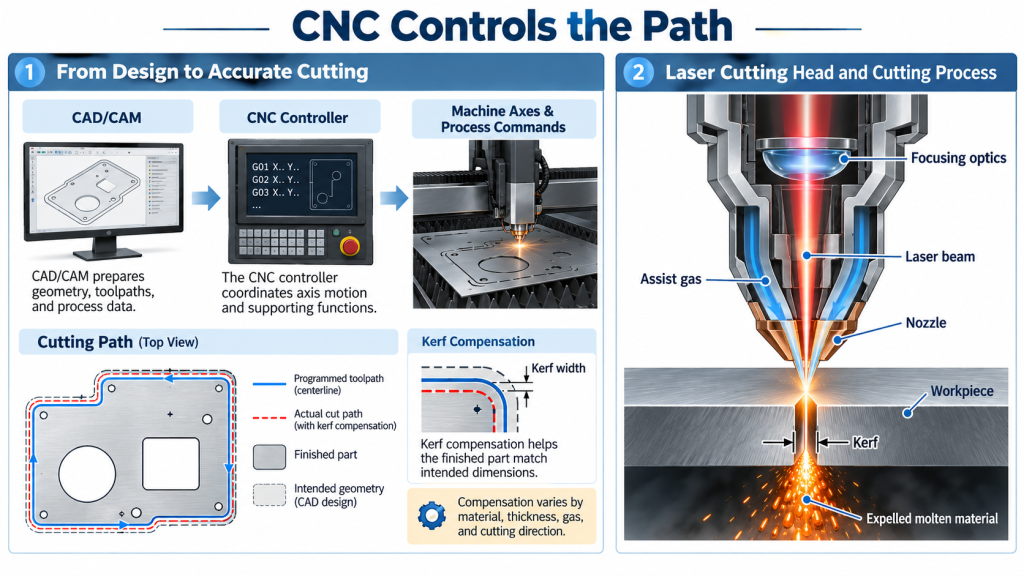
Laser cutting combines concentrated energy, controlled movement, and material removal. A focusing system concentrates the beam into a small spot. The machine moves that spot relative to the workpiece, following the programmed geometry.
The beam supplies heat
The material separates when concentrated energy melts, oxidizes, or vaporizes it. The exact mechanism depends on the material, laser, and process. Industrial metal cutting commonly combines localized melting with gas-assisted removal.
Assist gas clears the cut
Assist gas affects both separation and edge condition. Oxygen can add heat through an oxidation reaction. Nitrogen or argon can remove molten material while limiting oxidation. Gas type, purity, pressure, flow, and nozzle condition all influence the result.
The best gas choice depends partly on what happens after cutting. An edge intended for welding or coating may need different surface conditions from one that only needs to separate cleanly.
CNC controls the path
CNC—computer numerical control—coordinates movement and process commands. CAD/CAM software prepares geometry, toolpaths, and process information; the controller directs the machine’s axes and supporting functions.
Kerf is the width of material removed along the cutting path. A part needs suitable kerf compensation to match its intended dimensions. One compensation value will not suit every material, thickness, gas, and cutting direction.
What Makes Up a Laser Cutting Machine?
A working cutter needs much more than a laser source. The source generates the beam; the complete machine must deliver it, position it, hold the material, manage heat and fumes, and protect people.
| System | Main job | Beginner’s check |
|---|---|---|
| Laser source | Generates the beam | Is it suitable for the intended process? |
| Cutting head and optics | Focus the beam and deliver gas | Does the configuration match the task? |
| Motion and CNC | Follow the programmed path | Can it handle the required geometry? |
| Bed, chucks, and supports | Hold and support the workpiece | Can it manage its size, weight, and shape? |
| Gas and cooling | Support stable processing | Are supply requirements included? |
| Extraction and guarding | Control fumes and other hazards | Does protection cover the whole system? |
| Software | Prepare and manage jobs | Which functions and licenses are included? |
Machine footprint extends beyond the cutting area. Cooling, extraction, gas equipment, loading space, unloading space, and maintenance access all need room.
Laser Types, CNC Control, and Machine Formats
Laser labels describe different aspects of a machine. “Fiber” identifies laser technology, “CNC” identifies control, and “tube cutter” identifies the workpiece format. A machine can carry all three descriptions.
Laser source: fiber, CO₂, and other technologies
Different laser technologies have different wavelengths, outputs, and material compatibility. Fiber, CO₂, disk, and diode lasers are not interchangeable simply because their advertisements use the same word: cutter.
Industrial fiber laser systems commonly use near-infrared light for metal processing. Their usable capability still depends on the beam, optics, gas, motion, and validated process—not the source label alone.
Machine format: sheet, tube, and 3D
Sheet and tube cutters solve different workholding problems. Sheet machines typically specify a working area and load capacity. Tube machines must also manage cross-section, rotation, chucks, support, raw-stock length, and finished-part handling.
Tube cutting adds risks that a flat-sheet example cannot demonstrate. Tube bow, rotational eccentricity, weld seams, and the opposite wall can affect the result.
“3D” requires a closer look at actual movement. It may describe formed-part processing, robotic cutting, or a tube machine with a bevel head. Ask which axes move, what geometry they reach, and how the software handles collisions.
Which Materials Can It Cut?
Material compatibility belongs to a specific machine and process. Suitable systems can cut carbon steel, stainless steel, aluminum, copper, and brass, but each material needs its own validated operating conditions.
Reflectivity and heat conduction change the cutting challenge. Copper and aluminum require suitable equipment and process control; a power rating alone cannot establish compatibility.
Surface condition matters alongside material grade and thickness. Coatings, protective films, rust, oil, and batch variation can affect piercing, fumes, and edge quality.
A metal-cutting specification does not establish suitability for wood or plastics. Confirm the exact material, laser technology, extraction requirements, and approved process before treating a broad compatibility claim as usable guidance.
The Four-Gate Capability Check
A machine’s capability becomes clearer when you test four separate questions. This framework turns a vague “Can it cut this?” into a practical evaluation.
Gate 1: Does the workpiece fit?
The machine must accommodate the workpiece’s geometry and load. For sheet, check usable area and weight. For tube, check section, length, weight, chuck range, and support.
Gate 2: Can it move safely?
A workpiece that fits may still exceed the machine’s movement envelope. Rectangular tube corners sweep through a larger envelope during rotation. Long stock can sag or swing, changing support and clearance requirements.
Gate 3: Can it cut through?
Separation proves only that the process penetrates the material. A maximum-thickness demonstration may leave an edge, cycle time, or level of inconsistency that makes it unsuitable for production.
Gate 4: Can it repeatedly make acceptable parts?
Production capability requires repeated parts that meet agreed quality and output requirements. Test representative material, difficult features, complete cycles, and sustained operation. Define acceptance before the demonstration.
The purchase decision belongs at Gate 4. Passing the earlier gates establishes necessary conditions, not a production guarantee.
Laser Cutting Basics: Judging a Finished Part
A good cut must satisfy the drawing and the next operation. A visually smooth edge can still have incorrect dimensions, excessive taper, oxidation, or an assembly problem.
Check geometry and edge condition separately
Dimensional accuracy and cut-edge quality are different checks. Measure critical dimensions, hole positions, slots, and angles. Inspect roughness, dross, burrs, oxidation, and heat effects separately.
Axis positioning accuracy does not equal finished-part accuracy. Material variation, clamping, heat input, focus, and measurement methods all contribute to the final result.
Investigate defects before increasing power
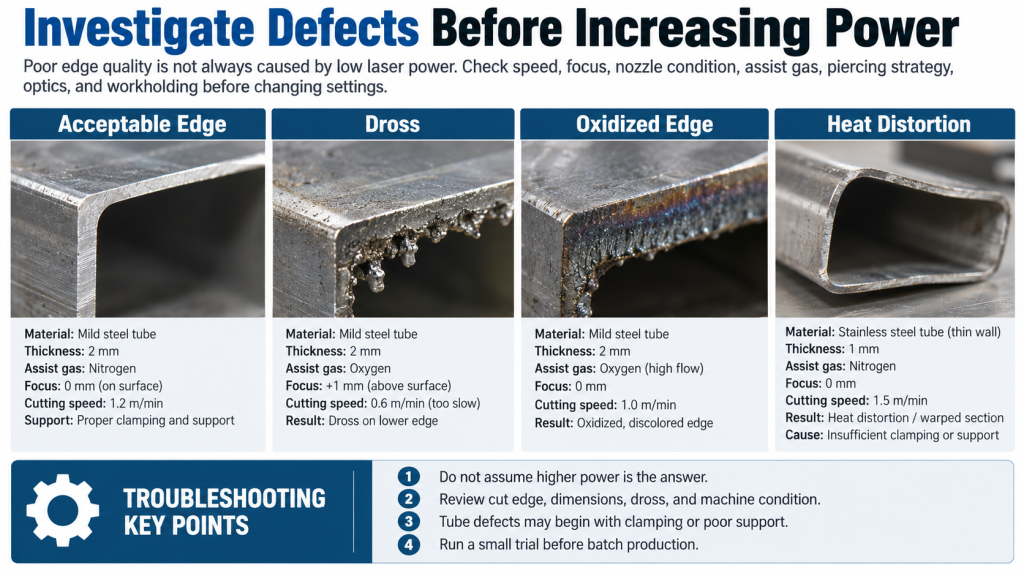
A poor edge does not automatically mean insufficient laser power. Dross or incomplete cutting can involve speed, focus, nozzle condition, gas, piercing strategy, or contaminated optics.
Tube defects can also begin in workholding. Excessive clamping can deform thin walls; inadequate support or eccentric clamping can disturb position and focus during rotation.
Parameter changes need a small trial before batch production. Check the cut, dimensions, dross, and machine condition before extending the revised settings to a full job.
Where Laser Cutting Technology Is Heading
Machine development extends beyond higher laser power into software, sensing, and material handling. Relevant capabilities include automatic nesting, geometry measurement, seam recognition, loading, unloading, sorting, and production-data interfaces.
Automation helps only when its individual steps suit the actual work. Automatic loading does not establish automatic changeover, sorting, fault recovery, or unattended operation. Verify each function and its material limits.
Complete-cycle output gives a better production picture than cutting speed alone. Include loading, measurement, adjustment, piercing, cutting, travel, unloading, and recovery. A faster beam cannot remove a bottleneck elsewhere in the cell.
What Beginners Should Learn First
Beginners need a part specification before they need a power recommendation. Record material grade, thickness, geometry, critical tolerances, edge requirements, batch size, and downstream operations.
Practical learning should cover files, workholding, process selection, and inspection. Students and hobbyists need approved materials and supervised machine access. Buyers need representative sample cuts and clearly defined acceptance conditions.
Safety requires a complete system and trained operation. Guarding, interlocks, extraction, cooling, pressure-gas controls, and maintenance procedures address different hazards. A laser-source rating alone cannot describe the safety of the assembled machine.
Frequently Asked Questions
Is a laser cutter the same as a CNC machine?
A laser cutter can be a CNC machine, but CNC does not mean laser. CNC describes computer-controlled motion and commands; the cutting process depends on the machine.
Does higher wattage always mean better cutting?
Higher power can expand some cutting windows, but it cannot guarantee better parts. Material, optics, gas, motion, workholding, and quality requirements still matter.
How thick can a laser cutting machine cut?
There is no universal thickness limit. Ask for a validated range for the material, configuration, gas, edge quality, and production rate you need.
Does laser cutting leave burrs?
Laser-cut parts can have burrs or dross. The outcome depends on the material and process, so deburring requirements need sample verification.
Why does laser cutting use nitrogen or oxygen?
The gases perform different process roles. Oxygen can support a heat-producing reaction; nitrogen helps eject molten material while limiting oxidation.
Can a sheet laser cutter also cut tubes?
Tube capability requires suitable hardware, control, and handling. A sheet specification alone proves nothing about tube clamping, rotation, support, or unloading.