
How Hot Does a Laser Cutter Get? Cut Front Temperatures
How hot does the metal get in the cutting zone? In one experiment on 304 stainless steel plate, the cut front averaged about 1,600 °C. The highest readings at individual points averaged about 2,000 °C. Both figures describe the metal surface the beam was actively cutting.
Where was the temperature near 2,000 °C measured?
The cut front is the surface where the beam removes material as the kerf advances. The focused beam concentrates energy in a small part of the workpiece, while assist gas from the nozzle carries molten material or reaction products out of the kerf.
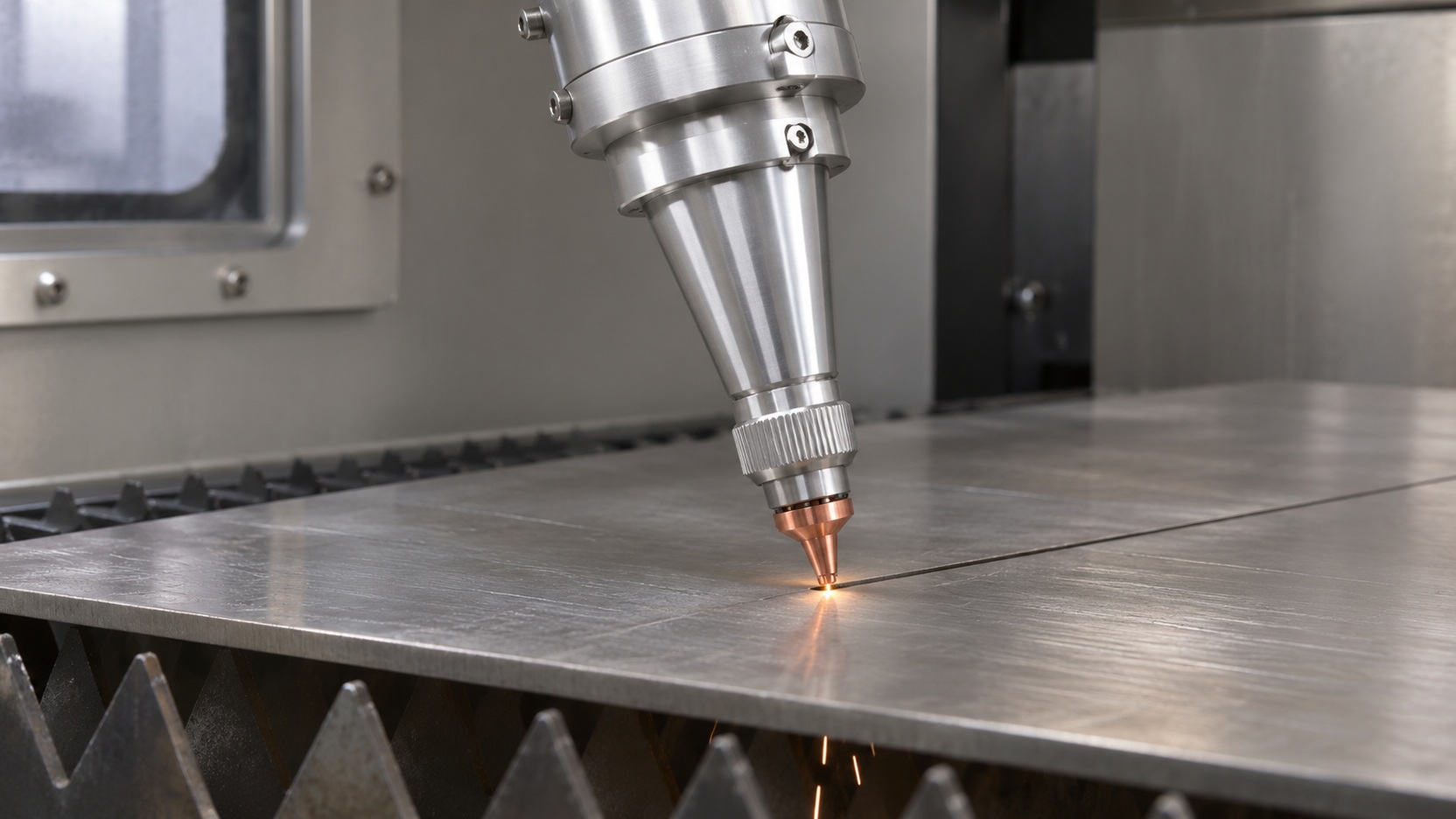
The researchers cut 10 mm thick 304 stainless steel plate with an 8 kW disk laser. They used nitrogen as the assist gas and a feed rate of 4.5 m/min. They recorded the cut front at 75,000 frames per second and determined its temperature using two-color pyrometry. The analysis covered 3 mm of cut over about 40 milliseconds, following the centerline of the cut front from the top of the plate to the bottom. Particles below the plate were excluded from the averages.
To obtain the figure of about 2,000 °C, the researchers took the highest reading at each depth over that time window and averaged those readings across the depth. The figure gives neither a temperature reached simultaneously across the cut front nor the machine's maximum temperature. The paper's DOI is 10.1007/s40516-025-00324-6.
The same spot can cool within microseconds
The high-speed images show molten metal forming local humps on the cut front. Hot spots on those humps move downward. One hot spot initially measured about 1,909 °C and moved down roughly 1 mm after about 27 microseconds. At 53 microseconds, the original location had cooled to about 1,297 °C, below the approximate melting temperature of 1,450 °C used as a reference in the paper.
As the hot spot moves, the surface exposed to the beam can change. A hump of molten metal can briefly shield the area directly below it from the beam. Cutting can continue while hotter molten areas and areas temporarily below the melting temperature coexist on the cut front. A single average hides that variation.
What changes with a different material or assist gas?
Nitrogen helps expel molten metal in this stainless steel experiment. In some oxygen-assisted carbon steel cutting processes, oxidation also adds heat to the cutting zone. Materials differ in how they absorb laser energy and conduct heat. Rated power describes nominal laser output and cannot by itself predict the cut-front temperature for a different workpiece.
Localized heating can also affect a tube. When closely spaced holes or slots are cut in succession, heat can build up nearby and cause deformation. That shows how the arrangement of features can affect local heating on the workpiece. It cannot tell you the temperature inside the kerf. Before applying an experimental temperature to a particular workpiece, check whether the measurement location and cutting conditions match.