
How Much Does It Cost to Run a Laser Cutter per Hour?
At US$0.15 per kWh, a small laser setup averaging 0.5 kW costs 7.5 cents per hour in electricity. An industrial metal-cutting setup averaging 12 kW costs $1.80 per hour in electricity. In the worked example below, adding purchased nitrogen and consumables brings that industrial setup to $9.00 per machine hour, or $0.15 per accepted part at 60 parts per hour. These figures use illustrative loads and prices. To estimate your own cost, use the electricity and gas consumed during a representative run, along with your local rates and replacement costs.
Calculate electricity from the whole setup
Electricity cost = metered energy (kWh) × electricity rate per kWh. If you have average electrical input in kilowatts, multiply it by the elapsed hours to get kWh. Include the cutter and the equipment it needs to run the job, such as the chiller, fume extractor, and any separately powered air-assist equipment. U.S. Department of Energy guide to calculating electricity use
The wattage in a laser’s model description usually refers to optical output, the power delivered by the laser beam. The electricity bill reflects the system’s electrical input. In one published test, a 2 kW fiber laser running at maximum optical output drew 14.3 kW at the machine-tool level with the cooling compressors and fans off, and 17.6 kW with them at maximum capacity. At the example tariff, holding those loads for one hour would cost about $2.15 and $2.64, respectively. Those figures describe the tested machine and cooling conditions. Kellens et al., Energy and Resource Efficiency of Laser Cutting Processes, Table 3
Use a kWh reading for a representative batch or shift that includes cutting, loading, and powered waiting time. If the cutter’s meter excludes a separately powered chiller or extractor, add that equipment’s consumption for the same period. If your utility charges different rates by time of day, apply each rate to the kWh used in that period. If the bill also includes a demand charge, check whether the cutter adds to the site’s billed peak and account for that charge separately. Measured laser-cutting power by operating mode · U.S. Department of Energy guide to utility rates
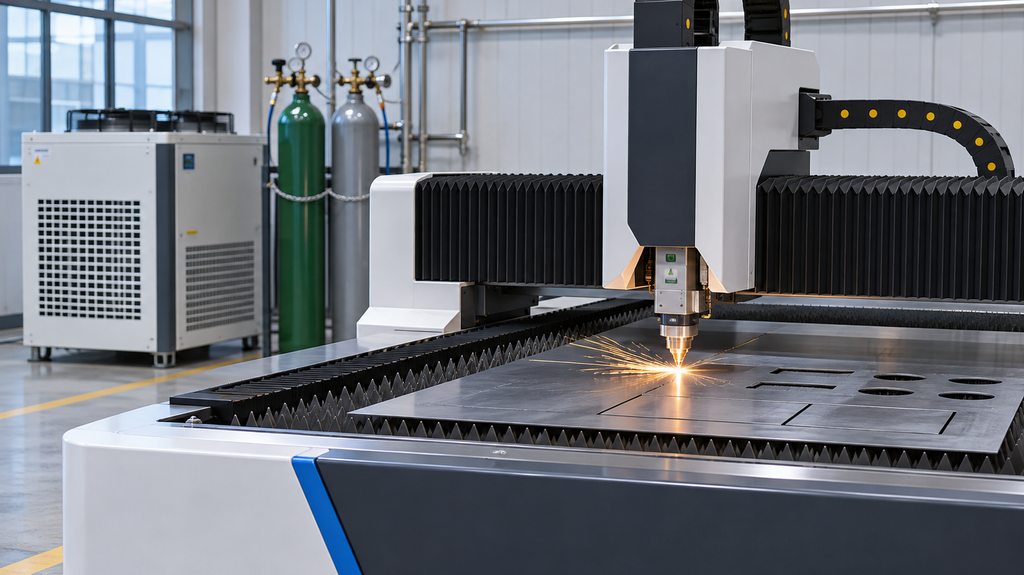
Price assist gas and consumables for the job
For purchased nitrogen or oxygen, multiply gas volume used × delivered price per unit of volume. Use a flow total for the run if available. For an estimate, multiply the flow for each relevant machine setting by the time gas actually flows, including piercing and purge time where applicable. Match the flow and invoice units, including the reference conditions if the supplier bills in normal or standard cubic meters. If cylinder rental or delivery is billed separately, include its allocated cost when comparing supply options. University of California manufacturing cost study, §6.7.12
Gas choice can change both cost and edge quality. Oxygen reacts with mild steel and adds heat to the cut. Nitrogen is used when the process calls for limiting oxidation, as in many stainless steel jobs. If compressed air is suitable for the material and edge requirement, include the compressor and dryer’s share of electricity and servicing. Compare gas options on the same material and thickness, and include any extra finishing needed to meet the edge specification. LUT University cutting experiments · U.S. Department of Energy compressed air sourcebook
For consumables such as nozzles, protective windows, or extraction filters, use replacement spending over a representative period divided by the machine hours in that period. For example, if a filter costs $120 and your records show 300 machine hours between changes, budget $0.40 per machine hour for that filter. Use the same definition of machine hours for the other costs you add to the estimate.
Convert machine-hour cost to cost per accepted part
Suppose a one-hour production run includes loading, cutting, and powered waiting time. All inputs below are hypothetical and in U.S. dollars.
| Cost for one machine hour | Calculation | Cost |
|---|---|---|
| Electricity | 12 kWh × $0.15/kWh | $1.80 |
| Purchased nitrogen | 15 m³ × $0.40/m³, on the same volume basis | $6.00 |
| Consumables and routine maintenance | Allocated from replacement and service costs | $1.20 |
| Direct machine running cost | $9.00 |
At 60 accepted parts, the direct machine cost is $0.15 per part. If the same $9 run yields only 40 accepted parts, it rises to about $0.23 per part. When comparing machines or cutting settings, use the same part drawing, material, and acceptance criteria. Record the elapsed batch time, kWh, gas used, and accepted quantity. For a full production quote, also include stock, labor, machine ownership, shop overhead, and any secondary finishing.
If you’re estimating costs for metal tube cutting, send your tube profile, material, wall thickness, and a sample drawing through our product inquiry page. Ask for the expected batch cycle time, assist-gas use, and electrical consumption for the proposed setup so you can apply your own utility and gas rates. JKingyun metal tube laser cutter inquiry