
How Much Power Is Required To Cut Metal? Judging By Material, Thickness And Beat
Taking industrial fiber laser cutting as an example, how thick can a 3 kW cut be depends on the metal material, auxiliary gas, and production requirements. In the 3 kW pipe cutting test of the Qingyun T9-AF6000, the wall thickness of stainless steel and carbon steel pipes was within 5 mm under conventional processing with nitrogen or air assistance. By 8 mm, the cutting limit for this working condition has been reached, with a speed of approximately 16–20 mm/s. The power is the same, but the production capacity has changed. When selecting power, first ask whether the parts you frequently make can be cut through according to the target beat and whether the cut edges can be accepted. Qingyun pipe cutting process data
Also 3 kW, why are the cut thicknesses different?
The 3 kW here refers to the rated optical output power of the laser. During cutting, the focused beam melts the metal in the cut, and the auxiliary gas sent from the nozzle blows the molten metal out of the cut. The effect of gases varies with the process. When cutting carbon steel, oxygen reacts with iron and releases heat, replenishing the heat for cutting while leaving an oxide layer on the cut edge. When cutting stainless steel with nitrogen, melting mainly relies on laser heating. Nitrogen is responsible for discharging the molten metal and inhibiting oxidation of the cut edges. If subsequent welding or spraying restricts the oxide layer, the data should be checked against the permitted gas when selecting the power. Qingyun Cutting Head Process Instructions · Steel Laser Cutting Power Test
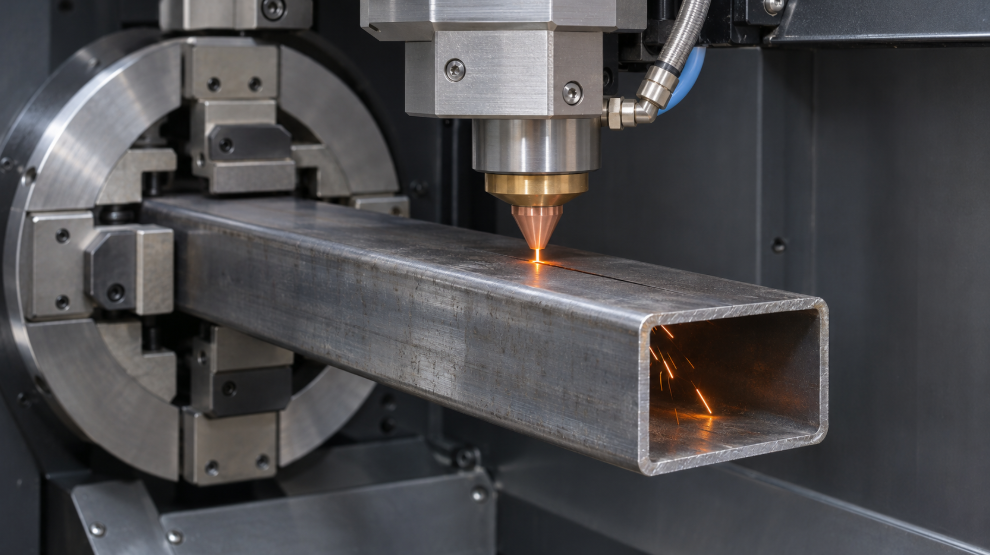
The same set of 3 kW pipe cutting equipment data released by Qingyun provides three working conditions. The thicknesses in the table are all pipe wall thicknesses. Qingyun T9-AF6000 cut-off tube test
| Tube material and assist gas | Routine wall thickness | Wall thickness at the cutting limit |
|---|---|---|
| Stainless steel or carbon steel, nitrogen or air | ≤5 mm | 8 mm at about 16–20 mm/s |
| Aluminum alloy, air or nitrogen | ≤4.5 mm | 6 mm |
| Carbon steel, oxygen, tube ID over 50 mm | ≤12 mm | Unreported |
When looking at the third row, both the tube inner diameter and the oxygen conditions must be preserved. If the drawings require nitrogen processing, the data under nitrogen conditions should be checked. The cut tube data should also be verified against the actual cross-section. Square pipe corners and bevels have different requirements for the cutting head to follow the pipe surface. When making such parts, the test cut should include the corner or bevel itself. Qingyun pipe cutting process data · Qingyun cutting head process description
What power is required to pass through and cut edges for the same thickness?
A plate test used fiber laser and nitrogen to cut a 10 mm thick 1.4301 stainless steel plate in a straight line. Under the experimental conditions listed in Figure 5 of the paper, the cut edge was good at 4 kW and approximately 1.0 m/min. When the speed is increased to about 1.2 m/min, the plate can still be cut through, but slag appears on the cut edges. After the test power was increased to 5 kW, clean sections were still obtained at a speed of 1.5 m/min. These speeds correspond to the straight-line test cuts in the paper. When using them to estimate the output of parts with holes, short sides, or corners, perforation, steering, and idle time must also be taken into account. The original text of the plate test is shown in Figure 5
There are also boundaries to speed reduction. In the above tests, cutting too fast will result in impermeable cutting, while cutting too low may also cause slag to form at the bottom of the cutting seam. When checking the thickness gauge of the equipment, look at the cutting speed and edge cutting results together. If a certain thickness can only be cut into a qualified piece when it is below the target beat, then understand this power level according to the ultimate capability. VTT sheet cutting test
Confirm the required power using the actual parts
- First check the process table of the corresponding equipment. Find the corresponding data by material grade, plate thickness or pipe wall thickness, and auxiliary gas. Re-check the pipe diameter, cross-section and whether a groove is required for the pipe fitting. Record the conventional processing speed to see if the commonly used thickness is close to the limit of this machine type.
- Test cut using formal drawings. Choose a part that is commonly made, and then choose a part that is most likely to get stuck in the beat or cut edge acceptance. Several pieces are processed continuously using the materials and gases planned for production, and the complete cut, slag hanging on the bottom edge, and the required dimensions and cut edges of the drawings are checked.
- Time is calculated based on the qualified parts. Record the processing time for each piece. If the straight line cuts quickly and the whole piece still times out, first check whether the time is spent on perforation, contour cutting or empty movement. If the main consumption is cutting, or if slag appears as soon as the speed is increased, then use the same parts and acceptance conditions to compare higher power levels.
Commonly used parts and difficult-to-cut parts can continuously meet the quality and rhythm requirements, which is why this power level has a basis for production.