
How To Clean A Laser Cutting Bed: The Difference Between The Processing Steps Of A Honeycomb Bed And A Pipe Cutter
To clean a laser cutting bed, first confirm what structure supports the workpiece. The support strips of detachable honeycomb nets and sheet metal cutting machines, as well as the chucks and material handling mechanisms of large laser pipe cutting machines, cannot share a single disassembly and cleaning method. Common honeycomb bed soaking tutorials when searching for “how to clean laser cutter bed” cannot be directly used for the entire device.
For honeycomb beds, cleaning can be carried out in one sequence: shutdown and safety confirmation, removal of loose debris, treatment of sticky residues according to material, followed by thorough drying and reinstallation inspection. If the working surface has deformed or burned, continuing to scrub will not solve the support problem.
First, separate the bed structure, then decide where to clear it
“Bed” here usually refers to the supporting working surface under the workpiece, not necessarily the structural bed of the machine tool. Before cleaning, you can confirm the object using the table below.
| Support type | Areas to inspect | Cleaning limits |
|---|---|---|
| Honeycomb bed on a small engraving or nonmetal cutting machine | Grid openings, upper and lower surfaces, and the debris tray underneath | Consider wet cleaning only if removal is permitted and the cleaner is compatible with the grid |
| Slat table on a metal sheet cutting machine | Slat tops, spaces between slats, and the slag collection area | Follow the table’s slag removal instructions; honeycomb degreasing methods do not automatically apply |
| Industrial laser tube cutting machine | Chucks, tube support contact surfaces, cutting area, and slag collection system | Follow the supplied configuration’s maintenance instructions for clamping, motion, and lubrication components |
This is especially important for pipe cutters. The long tube is clamped by a chuck and fed and rotated with the processing action; the support conditions also need to adapt to the length, weight and cross-sectional stiffness of the tube. Our website’s instructions for laser cutting metal pipes also clearly distinguish between the operating conditions for pipe clamping and sheet placement.
The following steps are mainly based on the removable honeycomb bed. The processing boundaries of large pipe cutting machines are listed below.
Cleaning a honeycomb bed: Remove debris first, then treat attachments
1.Complete smoke extraction and shutdown, and confirm the parts that can be disassembled
After cutting, smoke exhaust is completed according to equipment requirements, and the workpiece and residual material are allowed to cool before the shutdown and maintenance isolation procedures specified in the manual are executed. Do not pause the operation or press the emergency stop; use it directly as a basis for reaching into the equipment.
Confirm in advance how to remove the honeycomb bed, whether there are positioning parts, and whether the receiving tray below can be removed separately. When it is necessary to remove the cutting head or lifting table, the operation procedure of the corresponding machine type should be completed to avoid pushing moving parts to make room for cleaning.
2. Remove the scraps and check under the honeycomb network
First remove the larger scraps, then deal with the loose debris in the mesh and receiving tray. Vacuuming equipment must be suitable for the materials being collected; uncooled residues, sparks, and dust of unknown nature should not be directly inhaled into ordinary vacuum cleaners.
Don’t just look at the top surface. Small pieces passing through the honeycomb holes will fall down, and the bed will look clean, which does not mean that the material receiving area has been emptied. Stanford University’s maintenance instructions for its designated laser equipment list bottom tray cleaning separately, noting that long-term debris accumulation can create a fire hazard. Stanford University Equipment Maintenance Instructions
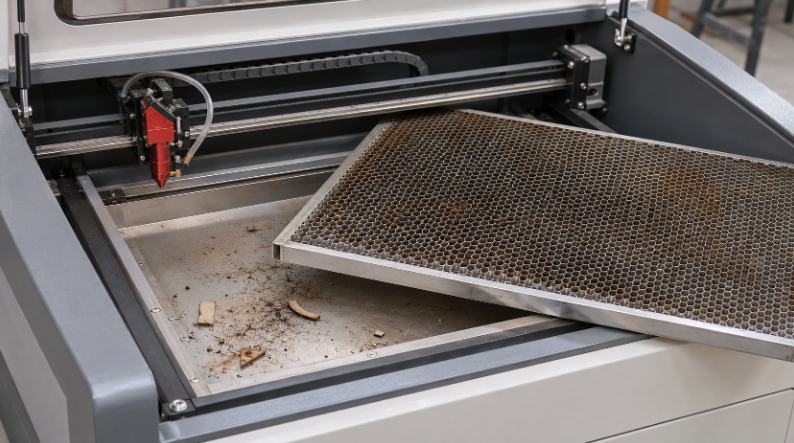
After this round of cleaning, check the remaining dirt: debris can be easily removed; firmly adhered residues require another method. Don’t spray detergent right away to turn loose dirt into wet mud that’s harder to collect.
3. Whether sticky residue can be wet washed depends on the material and coating
Before wet washing, three conditions need to be confirmed: the honeycomb network allows for off-machine cleaning, the cleaning agent is suitable for its metal and surface coating, and it can be fully rinsed and dried after cleaning.
You can’t choose a product based solely on the word “oil remover”. Verify the label, technical specifications, and safety data sheet (SDS) to confirm applicable materials, dilution requirements, contact time, and protection requirements; these information still cannot replace the equipment manufacturer’s confirmation of the bed’s suitability.
Stanford University maintenance documentation does provide a method for soaking cellular networks, but it is specific to their equipment and explicitly limits the soaking time, suggesting that over-soaking may damage the coating. This indicates that the formulation has applicable conditions and that other people’s concentrations and durations cannot be used as standards for all honeycomb beds. Stanford University Cellular Network Maintenance Instructions
If the manual does not allow wet washing, please confirm with the equipment supplier first. Do not use bed cleaner on lenses, protective windows, rails, or sensors.
4. Complete the permitted cleaning outside the machine, dry and reinstall
For cellular nets that have been confirmed to be removable and washable, handle the attachments outside the machine according to approved methods, remove any residue from the holes, and check whether the cleaning agent has been rinsed clean. Do not flush or spray large amounts of liquid directly into the machine to avoid disassembly steps.
Then wait for the mesh, frame, and connection gaps to dry completely before installing the device back. Stanford University’s regulations also explicitly require that cellular networks be completely dry before reinstallation; their cleaning waste is collected according to the campus hazardous waste process and cannot be discharged into sinks or rainwater outlets. The actual factory should determine the destination of the waste liquid by combining the cleaning agent, the cut materials, and local requirements.Stanford University Cleaning and Wastewater Treatment Procedures
After cleaning, how can we determine whether processing can be resumed?
Cleaning acceptance depends on the support and usage status. There are still color marks on the surface, so it is not necessary to continue adding medicine; the mesh is restored to its original state, but this does not mean that the deformed mesh can continue to be used.
After reinstalling, focus on checking the following:
- Whether the positioning is correct. The bed and receiving tray should be in place according to the original structure, without trapping debris or leaving loose positioning parts.
- Whether the workpiece is stable. If the plate shows any warping after it has been placed on, continue to check the support surface, installation position and residual protrusions.
- The mesh and the receiving area below should be visible and should not leave clumps of dirt or debris that could easily fall off again.
- If mesh collapse, frame warping, abnormal coating peeling or increased burn damage is found, the judgment is transferred to repair or replacement. Brushing it brighter will not restore the geometry.
After completing the re-inspection specified in the equipment manual, perform sample verification using the approved materials and processes. If there are still stains on the back of the workpiece, it is also necessary to distinguish between contact transfer, cutting and burning, and smoke exhaust problems. The amount of cleaning agent cannot be increased based solely on the stains.
Large laser pipe cutter: Cleaning focus on clamping, supporting and slag collecting paths
Maintenance of large pipe cutting machines should revolve around the actual mechanism. Taking our own A22-C laser pipe cutter as an example, the public configuration includes dual chucks and semi-automatic feeding. Options such as pipe support and slag discharge still need to be confirmed according to the project. Such equipment requires cleanup projects based on delivery configuration, and cellular bed tutorials cannot cover its maintenance requirements.
Provided that maintenance isolation has been completed, the inspection should focus on three locations: the blanking and slag accumulation in the cutting area, the attachments on the contact surface of the support material, and the accessible areas of the chuck that allow operators to clean. Before entering the equipment, please confirm according to the manual that the pipes, clamping mechanism and pneumatic energy storage systems are in a state that allows maintenance.
Cleanup and adjustments should also be separated. Removing visible debris does not mean that the chuck can be disassembled, the clamping surface scraped, or the support height changed; these actions involve clamping and supporting states and should be performed by qualified personnel in accordance with maintenance documents.
If pipe slippage, abnormal rotation, or dimensional fluctuations still occur after cleaning, the clamping, support, and processing conditions should continue to be checked. The operating instructions for the pipe cutter on our website state that pipe sagging and displacement during rotation can affect hole position, profile, and focal distance, and these problems cannot be entirely attributed to dirt.
The cleaning frequency should be adjusted according to the residual state
Do not write “once a week” as a fixed cycle for all devices. Cutting materials, operating time, smoke extraction performance, and the on-site environment all alter the rate of soiling. The University of Pennsylvania’s laser cutting safety documentation also requires that maintenance plans incorporate these conditions and cover recommendations from the corresponding equipment manufacturers. University of Pennsylvania Laser Cutting Safety Data
The workshop can leave specific status in the inspection record: whether the mesh is blocked, whether the receiving tray is full, whether there are protrusions on the support contact surface, and whether dirt accumulates again soon after cleaning. If pollution accumulates too quickly again, the smoke exhaust and process conditions should be verified; shortening the cleaning interval is only one measure.
Before resuming production, three results were confirmed: the dirt had been removed, the supporting structure remained intact, and the equipment had completed the restart verification according to the manual. The task of the bed is to stabilize the supporting workpiece, and cleaning should serve this result.