
What are the auxiliary gases for laser cutting machines? How to choose oxygen, nitrogen and compressed air
Three auxiliary gases are commonly used in metal laser cutting machines: oxygen (O₂), nitrogen (N₂), and compressed air. All three are blown into the cutting seam from the cutting head nozzle, discharging molten metal from the bottom surface of the sheet. The difference lies in whether the gas participates in the reaction. Oxygen reacts with hot metal to replenish heat for cutting low-carbon steel. Nitrogen can inhibit the oxidation of cut edges. Compressed air can also expel molten metal, but the oxygen in it may still cause the cut edges to oxidize and discolor. Argon is also used in some alloy processes; for example, comparative tests have been conducted on aluminum-copper alloys. University of Nottingham fiber laser cutting research Assist gas comparison on S235 structural steel University of Vigo aluminum alloy cutting study
Oxygen is heated by reaction, and an oxide layer will form on the cut edge of low carbon steel
When cutting low-carbon steel, oxygen blows the molten material out of the cutting seam while reacting with the iron at the cutting front and releasing heat. When encountering thicker low-carbon steel plates, especially when the equipment uses nitrogen, which is difficult to cut through stably, oxygen is a process that deserves priority verification. The reaction also leaves an oxide layer. If the cut edges of the drawings require no oxide scale, or if the subsequent spraying process requires the removal of the oxide layer, the cleaning process should be included in the comparison. University of Nottingham mild steel cutting trials, Chapter 4
Nitrogen inhibits oxidation and is suitable for workpieces with appearance requirements for stainless steel cutting edges
When cutting stainless steel with nitrogen, the laser is responsible for melting the metal, and the nitrogen jet pushes the molten material out of the cut seam while reducing the contact between the high-temperature cut edge and oxygen. When the exposed edge requires the preservation of the metal’s natural color, or when subsequent processes have clear restrictions on edge oxidation, nitrogen can be used as a sample first. The color of the cut edge and the slag on the bottom surface should be viewed separately. Even if the cut edge is metallic in color and the molten material is not discharged sufficiently, it may still condense into slag at the bottom of the plate. The inspection should be done inside out during acceptance. University of Nottingham fiber laser cutting research, Section 2.5
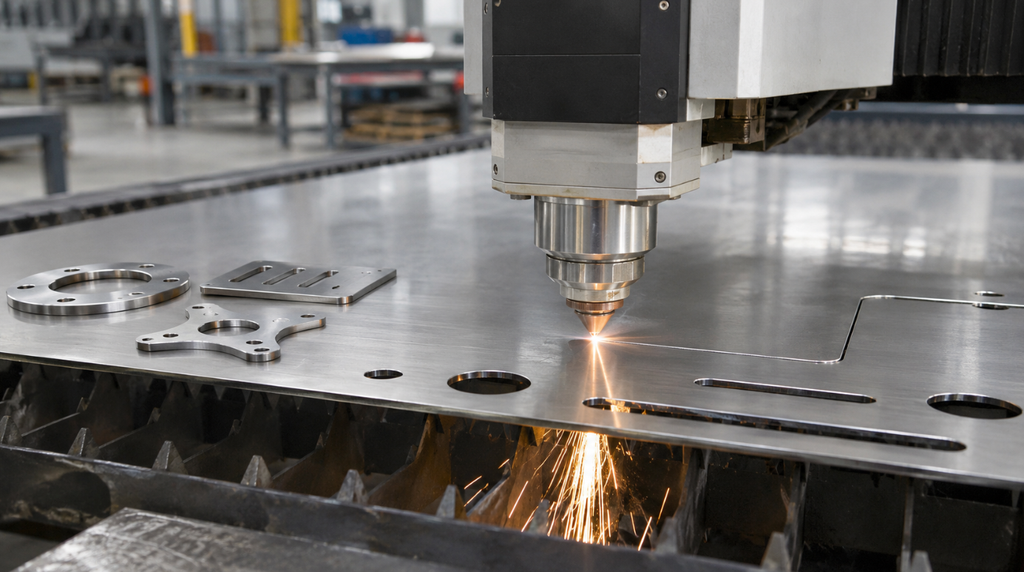
Compressed air can discharge slag, and the cut edges may still change color
Compressed air contains approximately 21% oxygen. Even after drying and filtration, oxidative discoloration may still occur during cutting. When parts allow for a certain degree of discoloration and the machine tool supports cutting with compressed air, the actual parts can be used to verify whether the dimensions and slag can meet the standards. The air source must also be checked according to the cutting conditions to confirm that the pressure, flow rate and air quality requirements specified by the machine tool can be continuously met during the cutting process. Study on air-assisted laser cutting of 304 stainless steel
If the hole diameter is acceptable, slag may also be hanging from the hole opening. An S235 structural steel fiber laser test found that under the working conditions used in the study, the size of some small holes cut by compressed air was closer to the design value, but there was still obvious slag hanging on the bottom surface of the hole, which required additional cleaning. When a part has small holes or narrow grooves, the specimen should bear these features, and a straight cut will not reveal the bottom surface of the small hole. S235 structural steel small-hole trials, Section 4.3
Air exchange test cutting, acceptance according to drawings and next process
Using plates of the same grade and thickness and the same part pattern, test cut according to the process parameters given by the machine tool for each gas. During ventilation, check the nozzle, focus, cutting speed, and air supply pressure together. First confirm that the parts can be cut completely and the characteristic dimensions such as small holes are qualified. Then check whether there is any discoloration or oxide layer on the cut edge that exceeds the acceptance requirements, and turn over to check the slag. If the parts are subsequently welded or sprayed, confirm whether the cut edges need to be cleaned according to the requirements of the corresponding process. When both gases can be cut through, the impact of ventilation on the entire process can only be seen by comparing the cutting and cleaning time of each qualified product. S235 structural steel trial settings and cut-edge evaluation