
What Industries Use Laser Cutting? 8 Applicationswhich Industries Use Laser Cutting? 8 Types Of Applications, Typical Parts And Acceptance Priorities
Laser cutting is used in sheet metal processing, automotive, aerospace, medical devices, electronics, lithium batteries, textiles and clothing, and logo making. The difference lies in the process. Cabinet panels are typically cut out of the flat plate and then bent. Hot-stamped body parts can be formed first and then trimmed with laser. When it comes to the medical device production line, the laser can also cut out the bracket grid along the nickel-titanium thin-walled tube. After cutting, the inner wall of the tube opposite the incision must also be inspected. Sheet metal processing experiments at the Australian National University · Hot stamping boron steel cutting research · Bracket cutting research at the University of Manchester
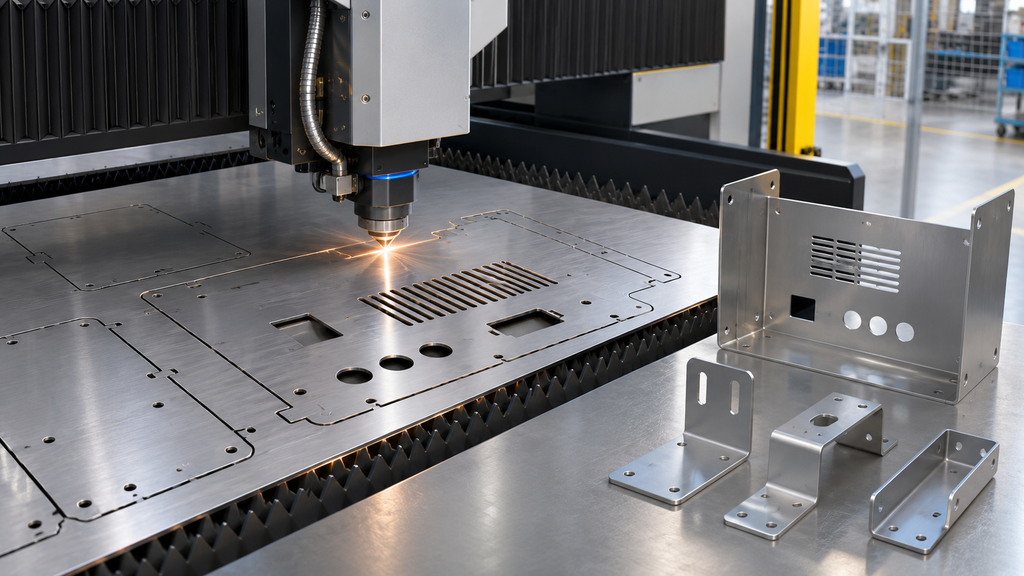
1.Sheet metal processing: Cabinet panels and brackets are cut first and then folded
Equipment cabinets, control boxes, and mounting brackets are typically unloaded from the flat plate. Taking the control box panel as an example, the laser cuts out the outer contour, mounting holes and connector openings along the unfolded diagram, and then folds out the flange. A trial at the Australian National University used the same process, first cutting positioning holes and slots in a 0.85 mm sheet metal blank, and then folding it into a slot-shaped piece. The dimensions of these parts need to be checked twice. During the flat plate stage, check the holes and openings, bend them, and then review the hole positions and assembly gaps according to the finished product standards. Even if the hole spacing of the flat plate is acceptable, the deviation in bending angle may cause the holes on different surfaces to be misaligned. Australian National University sheet metal fabrication study, Appendix A.1
2.Automotive manufacturing: hot stamping body parts after shaping and trimming
Hot-stamped boron steel parts for white bodies are formed and hardened in a mold, and excess edge material must be removed later. Once steel parts harden, mechanical trimming requires more force, and the cutting tools are more prone to wear. Lasers can trim edges along the contour of a molded part. The trimming profile should be measured according to the positioning reference of the molded part, and the lower edge of the cut should be checked for slag. Contour deviation will affect the lap position, and the hanging debris left on the lap edge may make the two plates not fit tightly. Laser cutting trials on hot-stamped boron steel
3.Aerospace: Confirm whether the cut edge can be retained after the alloy sheet is unloaded
Laser cutting is used in the manufacture of aircraft engine parts. Taking Ti‑6Al‑4V titanium alloy thin plates as an example, a heat-affected zone may be formed next to the cut, that is, a zone where the material changes due to heat even though it has not melted, or its tissue or hardness. Whether this area can be retained for parts subjected to repeated loads must be confirmed according to the drawings and approved processes. The report submitted by Italy to the International Commission on Aviation Fatigue and Structural Integrity documented a set of comparative tests. Under these test conditions, the laser-cut Ti‑6Al‑4V specimens showed a non-negligible fatigue performance degradation compared with the mechanically cut specimens. If the process requires cutting before processing, an allowance should be reserved when unloading. South Coast Air Quality Management District process survey · Italian national review for the International Committee on Aeronautical Fatigue and Structural Integrity, Section 3.1.4
4.Medical devices: Cutting a stent grid into a thin-walled metal tube
Some vascular stents use nickel-titanium alloy thin-walled tubes as blanks. The laser removes the openings in the grid, leaving behind connected thin supports. Once the cut is wide, less material will be left for the support rod. Therefore, the width of the support rod must be measured after the outer diameter is met. The inner wall should also be viewed. The University of Manchester’s stent cutting study examined damage to the inner wall of the tube opposite the cut, as well as debris and recast layers. The latter is a layer formed by the material that melts during cutting resolidifying at the edges. For this type of pipe fittings, the first inspection should clarify which dimensions are measured after cutting and which surfaces require acceptance after post-processing. Coronary Stent Cutting Study at the University of Manchester
5.Electronics manufacturing: Check for cut edge residue when cutting flexible circuit boards
Flexible printed circuit boards (FPCBs) can be cut along their shape using lasers. The board has copper and polymer layers. If the tangent line is close to the line, even if the contour size is qualified, check the edge for conductive particles or carbonization residue. In the cutting test of flexible copper-clad plates, the Korea Institute of Mechanical Materials listed the short circuit caused by conductive particles and thermal effects as a key issue. The first one can combine edge cutting inspection with electrical testing, with particular attention to the position of the tangent line close to the adjacent conductor. Laser cutting test of flexible printed circuit board
6.Lithium battery manufacturing: cutting coated pole pieces and forming pole ear contours
The core manufacturing process uses laser cutting to coat the pole pieces, and can also cut the pole ear contours along the edges for subsequent connections. The pole piece consists of a metal current collector and an active material coating, with the cut edge spanning both materials. During inspection, it is necessary to check whether there is slag or splashed particles on the metal edge, and also to check whether there is abnormal shrinkage of the coating near the cut. The detachable conductive particles may cause an internal short circuit after entering the battery core, so only the shape of the electrode is measured, which can easily miss defects that directly affect the quality of the battery core. Fraunhofer IWS electrode cutting trials · Copper current collector cut-edge study
7.Textiles and clothing: When cutting into pieces, the cut edges are also heated
When laser cutting polyester knitted fabrics, the cut fibers can bond after local melting, reducing loose edges. Microscopic observations documented this fusion edge. The edges of the fabric may also become stiff as a result. For skin-to-skin tailoring, you can use actual fabric to make a sample and check the feel of the exposed edges. If the cut piece still needs to be sewn, try sewing it according to the finished product stack to see if the melted edge will make the seam stiff. Microscopy study of laser-cut polyester edges · Fraunhofer ILT knitted polyester cutting trials
8.Logo production: Cut out acrylic shapes to take into account both appearance and inlay
Acrylic lettering and openwork logo panels can be cut along vector outlines. When making openwork lettering, closed letters like O need to have connecting bridges in the glyphs, or the inner core needs to be fixed separately. When making embedded characters, you need to test match them with actual board thickness. The width of the cut varies with the material and thickness, and the cut surface may also have a slope. Only measure the width of the front text, which may miss the problem of the back getting stuck or the seams not being evenly distributed after installation.California State University Long Beach signage application · University of Illinois Chicago laser cutting design rules
When the first sample is sent, specify which dimensions are accepted in which process
Mark the material grade, thickness, or laminate structure and key cuts on the drawing, and indicate the acceptance status. For example, the chassis mounting holes should be measured against a bent reference, the acrylic inserts should be test-installed using a matching panel, and the battery pole pieces should indicate the inspection methods for edge-cutting particles and coating shrinkage. To verify mass production conditions, the first piece should use the materials planned for production and subsequent processes. The hole position, assembly clearance and edge cutting quality measured in this way correspond to the actual delivered parts.